
It’s 10 p.m. Do you know where your competitors are?

Somewhere out there, your competitor is publishing content, running ads, and quietly winning over customers you could have had. The question is whether you know about it.
You probably already take a peek at what they are up to (we’ve all stalked our exes on Instagram, amiright?), but this blog is going to give you a roadmap so your research actually leads somewhere.
This type of research is called competitive intelligence, and as a former competitive intelligence specialist turned marketer, here’s my case for why it’s worth your time:
- You protect and sharpen your competitive advantage
- You come away with fresh marketing ideas
- And honestly, it’s kind of fun
Let’s get into it.

Who are my competitors?
You have colleagues who talk to customers every day, and they already know who’s eating your lunch. Your sales team has a short and very personal list of nemeses compiled from every lost deal. Your support team hears customers threaten to switch on a regular basis. Talk to these teams and ask directly.
From there, put on your customer’s hat and try to find your own company. Say you own a car mechanic franchise. Your customer is probably googling “car mechanic near me” or checking Reddit for recommendations. Maybe they’re having a quick Claude or ChatGPT conversation. Who shows up? Follow that trail. Depending on your industry, trade shows, peer review sites, industry reports, and market research companies can round out the picture nicely, too. In B2B, one of the fastest ways is to do a Google search as if you are your customer seeking your service and see who comes up (pro-tip: make sure you’re using incognito mode for non-personalized results).
Where are my competitors?
They’re (hopefully) minding their own business. Building their product, serving their existing customers, and plotting their next move. And every strategic decision they make leaves a trace somewhere online.
The content they publish, the ads they run, the jobs they post, and the keywords they chase all add up to a surprisingly clear picture of where they are today and where they’re headed tomorrow. You just need to know where to look.

Channel: Website
Most people skim a competitor website once and move on. That’s a mistake, because if you read it carefully it’s one of the most revealing data sources you have. Here’s what you’ll find:
- How they frame their market positioning and who they are targeting
- How serious they are about growth
- Where they’re headed next
Homepage
Start there and read it like a first-time customer. What problem are they solving, how and for whom? Customer logos and reviews are particularly useful here because they show you exactly who they are winning over. If you are D2C, take note of any special offers, promotions or seasonal deals, as these tell you what they think convinces people to act. If you’re B2B, try to see if you can understand what niche or pain point(s) they’re going after.
Services
Look at how they package their offering and describe the problem(s) they solve. Check for social proof like case studies, KPIs, and customer mentions. Take notice about where proof points show up, too. A competitor with plenty of proof around one service but nothing to show for another is telling you more than they realize. Often, this reveals where they have real traction versus where they’re still fighting for market share. Same thing goes for “types of clients” or industries you find evidence around.
Careers
Check out what positions they’re hiring for and in which locations. A wave of sales hires means they’re growing. Engineering hires signal product investment.
Blog, webinars & PR
Look at whether they’re publishing regularly and how consistent the cadence is. Recurring themes in their content reveal what they believe matters most to their target market. Also check for gated content like white papers or downloadable guides, which point to an active lead generation strategy.
Email newsletter
Check for a newsletter signup in the footer or a pop-up. If they have one, it tells you how seriously they take email marketing and content. Subscribe and pay attention to how often they send, what they promote, and whether it’s a regular educational series or just the occasional one-off announcement. This can give you an idea of how strategic their marketing is.
Channel: Social media
Social media is where your competitors show their personality, whether they mean to or not. Pay attention to:
- How much effort is going into showing up
- Whether anyone is actually listening
- Paid, organic, or a bit of both
- What platforms they’re prioritizing
Most platforms follow the same logic. Look at posting frequency, content themes, engagement, and paid activity. What changes is the audience and format. What kind of content are they publishing? Do they seem to appeal to different audiences or have visibly different strategies across social accounts?

For B2B this is the one to watch most closely. Check the company page but also spend time on the leadership and employee profiles, as employees often tell a richer story than the brand account. For paid activity, the LinkedIn Ads Library shows their more strategic messaging. What formats are they running and is the spend consistent or seasonal? Can you tell where they are focusing on efforts based on the PPC spend?
Meta (Facebook & Instagram)
Is the content identical across platforms or tailored to the audience? Compare the engagement and head to the Meta Ad Library to see all active paid ads across both platforms.
X
Same content audit as above. The bigger question here is whether there’s any meaningful engagement at all. For many B2B companies, this channel is an afterthought or only used during events. There’s been a trend of folks moving away from X so see if that’s the case in terms of your audience, industry, and competitors.
YouTube
Do they have a channel and are they actually using it? Look for webinar recordings, educational content, and customer stories in video format. A channel that started strong and went quiet tells you the strategy didn’t stick. Of course, the biggest tell here is that you can start to see if they’re investing in video or not.
TikTok
TikTok’s the wild card. Some companies are genuinely building an audience there, others created an account in 2022 and lost their password. Figure out which one your competitors are.
Channel: Google & search engines
Google is where the world talks about your competitors. And unlike everything else we’ve covered so far, most of it is content they did not write themselves. Here’s what to pay attention to:
- Whether they are spending on paid ads
- What people are actually saying about them
- What they did not mean to make public

News & PR
Search their company name in Google News and use negative keywords to filter out the noise. This means excluding terms like jobs, employees, and reviews to focus on what is actually relevant
A pattern of press releases can signal funding rounds, new partnerships, service expansions, or leadership changes.
Google Business Profile
Not a traditional marketing channel, but worth a quick scan. Reviews and response patterns tell you something about their customer experience and reputation on the ground.
Google Ads Library
Check whether they are running ads and what the messaging looks like. If they’re bidding on your brand name, that’s a deliberate move and tells you they’re actively trying to intercept your customers.
Pro tip: Google Advanced Search
This is the sneaky one.Use Google’s advanced search operators to find documents your competitor published but never really meant to highlight. Sales guides, pricing documents, one-pagers and internal resources that were never intended to be public can be more revealing than anything on their homepage.
Example: site:slack.com filetype:pdf
God-tier investigation
If you made it this far, you’re already more thorough than most of your competitors. Here are a few more tools worth adding to your arsenal.
- Google Alerts – Set up alerts for your competitors’ names and you will get notified any time they get mentioned online, without having to go looking for it.
- Semrush or Ahrefs – Run their domain to see what is actually driving traffic. The content gap feature alone is worth it, it shows you exactly what to write and rank for.
- Job openings (on LinkedIn) – A sudden wave of hires in a new region, a function that never existed before, or a role that seems oddly specific can all signal where they are headed next.
- Web archive – Watch how their website has evolved. How their story shifted tells you how the market shifted.
- BuiltWith – See their marketing tech stack. Because a sophisticated setup signals a team that is serious about marketing and data while a bare bones one suggests the opposite.
What are my competitors trying to do?
Knowing which channels your competitors are active on is a good start. Knowing what they’re actually trying to do with each post? That’s where it gets interesting.
Enter: the marketing funnel. Here’s where you try to map out how they are attempting to raise buying temperature and create a full funnel experience.
You can apply it to a content audit, a campaign review, a website deep dive, or a social media monitoring pass. The question you’re asking is the same one across all three stages:
- TOFU: Is this content trying to get someone’s attention?
- MOFU: Is this content trying to earn someone’s consideration?
- BOFU: Is this content trying to move someone to an action?

Let’s put it all our learnings into practice, using Belay, a company that provides virtual assistant services to small business owners and entrepreneurs.
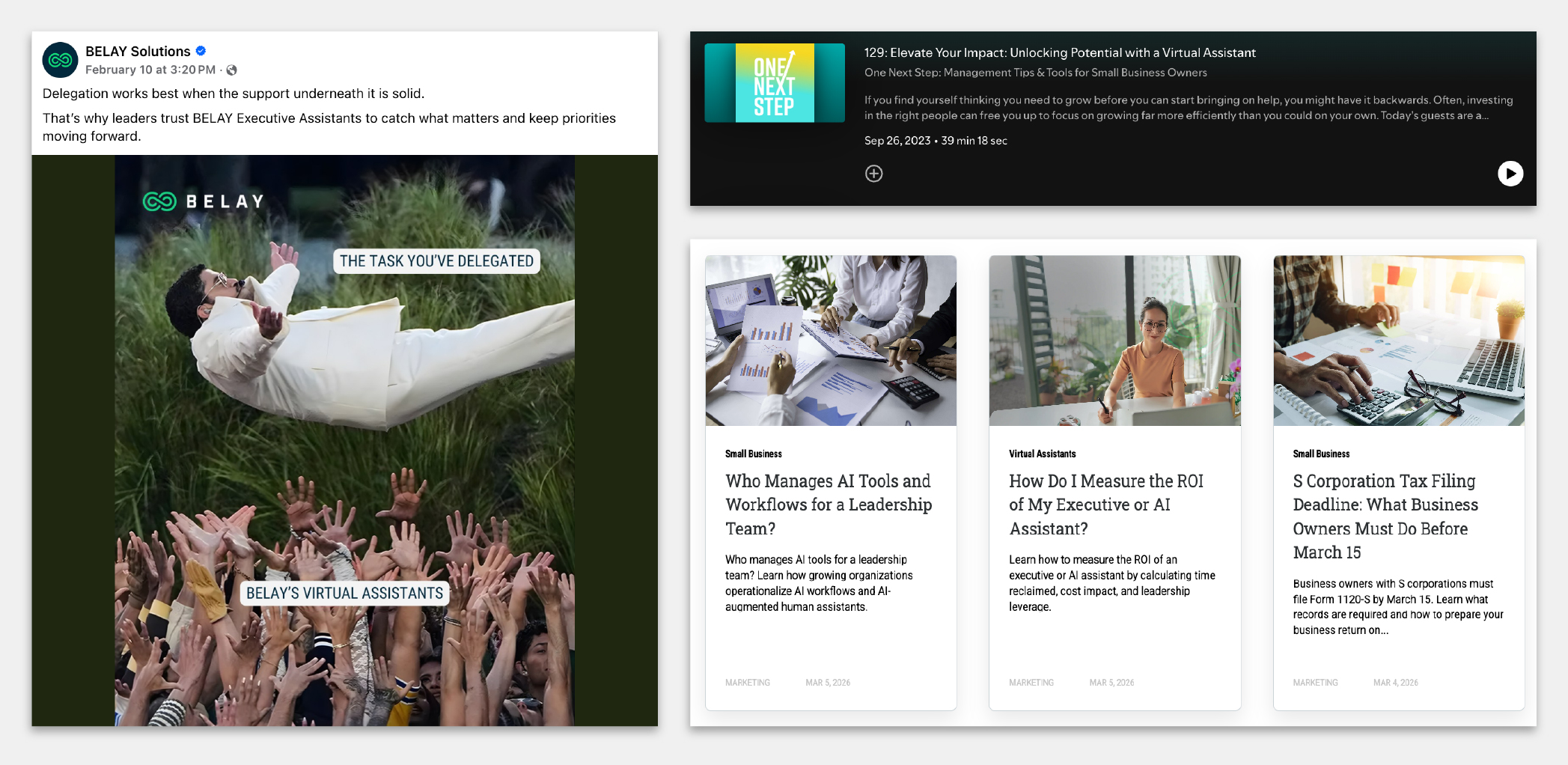
TOFU: Building awareness
Belay runs a high volume awareness engine across multiple channels, consistently showing up where small business owners are already spending their time.
- Blog – Roughly one piece per day, leaning heavily into “what is” style posts and helpful how-to content, with the majority focused on small business owners’ needs.
- LinkedIn, Facebook and Instagram – Video-first content around delegating and tips for leadership, with the same posts carrying across all three platforms and the occasional meme on Facebook to keep things lighter.
- Podcast and third party appearances – Over 100 episodes that have since been paused, pivoting to a guest appearance strategy with their leadership showing up regularly on other shows and podcasts.
- YouTube – Longer form videos were replaced by simple talking head shorts, with content distributed across other social media channels.
- TikTok and X – Quietly deprioritized. Both had some content but never enough attention or tailoring to really take off.
MOFU: Earning consideration
Once someone is aware they have a problem, Belay shifts from helpful content to showing what the solution actually looks like.
- Gated content – Downloadable guides and resources for an audience that has moved past “do I have a problem” and is now asking “what do I do about it.”
- LinkedIn Webinars – A smart format because it presents their team as the authority while naturally demonstrating the service in action.
- Live Q&As on Instagram – Keeping the conversation going in a more casual, low commitment format for a warmer audience.

BOFU: Getting a conversion
For buyers who are ready, Belay makes it easy to reach out or close a deal.
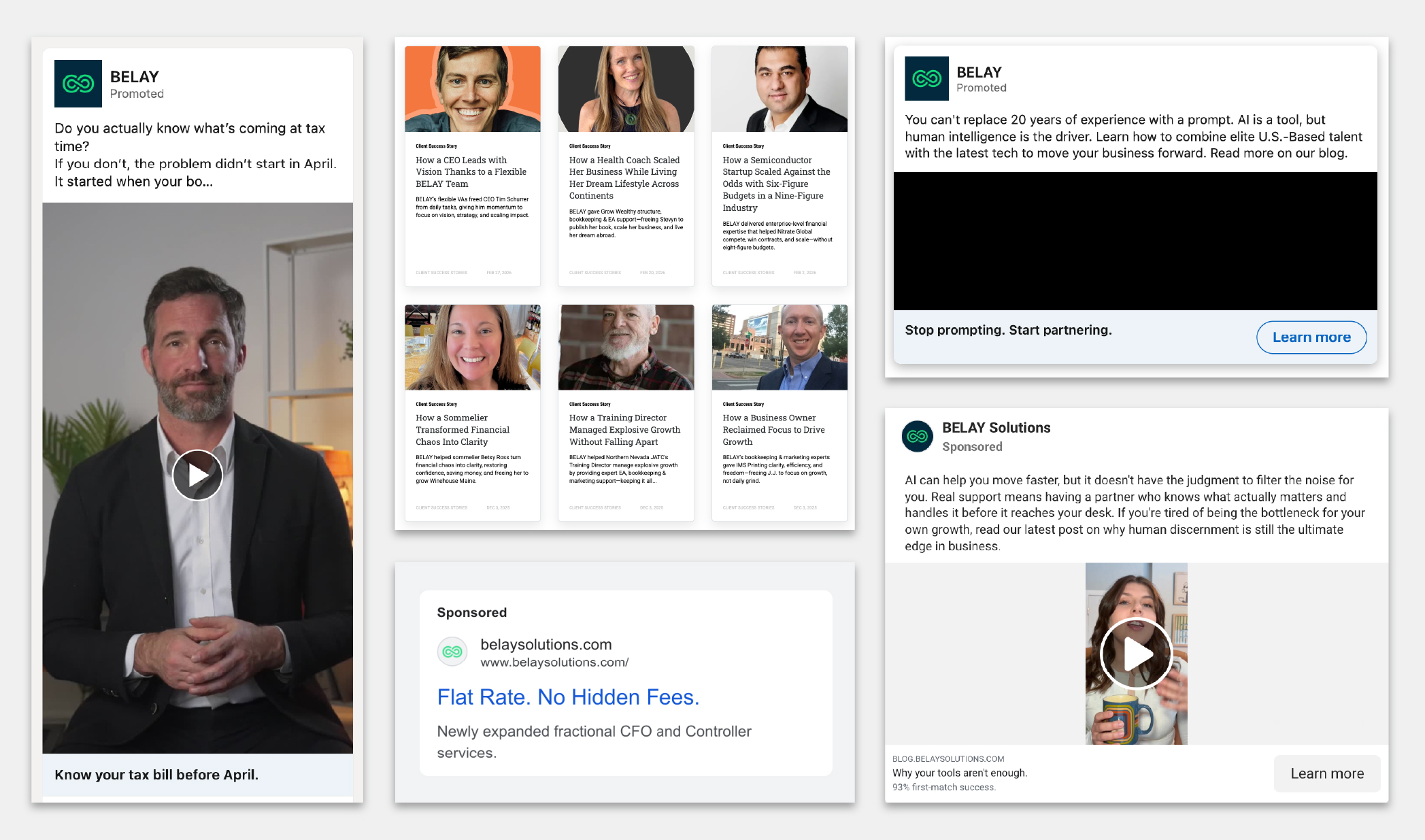
- Case studies – Real client stories (also in video) that start connecting the problem to a tangible outcome. And the format matters more than most people think.
- Google search and display ads – Direct CTAs targeting people who are actively searching for the solution with high intent to buy.
- LinkedIn and Meta video ads – Consistent messaging positioning Belay against AI solutions, meeting the biggest objection a ready buyer has head on.
- Paid partnerships – Influencer campaigns with direct CTAs pushing a warm audience toward getting started.
Your B2B competitive intelligence template
We put together a framework so you don’t have to start from a blank page. It keeps you focused, stops you from going down a three-hour rabbit hole, and makes sure you walk away with something you can actually act on.
A little gift from us to you.
What to do with everything you just found
Antoine Lavoisier, a renowned French chemist, once said that nothing is lost, nothing is created, everything is transformed.
The same applies to marketing strategies. Most of what your competitors are doing, they picked up from somewhere else, too. Writing blogs about work delegation or running LinkedIn video ads isn’t a revolutionary idea. What matters is what you do with the insight.

What you can use
You’re not going to act on everything you find, and you shouldn’t try to. Pick the moves that close the gap between where you are and where you want to be.
Start with the big strategic questions
Where does your content fall short compared to theirs? Are they serving certain industries or customer segments better than you are? Are they leaning heavily into awareness content while you are sitting at the bottom of the funnel with no one to convert? These questions tell you where traffic is flowing and which audiences you might be missing entirely. Competitor analysis at this level feeds directly into strategic decision making.
Update your content strategy
Check what is actually getting engagement, not just what is being published. Maybe compliance content is getting crickets but a topic you have been ignoring is generating real conversation. Are people asking questions in the comments that nobody is answering? That’s your opportunity.
Differentiate your messaging
Everyone is out here “streamlining efficiency and unlocking the power of workflow” (whatever that means). The real gap is the pain point nobody is addressing. That starts with knowing who you are talking to. If you want to go deeper on this, we wrote about how brand positioning shapes the way customers see you.
Test the formats and channels they are running
If a competitor is seeing strong results with a particular ad format or platform, run the same format with your own messaging and see how it performs. Think of it as using available information to make a smarter bet.
Build assets your sales team can actually use
Reports, battlecards and well-designed sell sheets give your sales reps something concrete to reach for when a competitor’s name gets dropped on a call.
Consider opening a channel nobody else is using
This can be a genuine differentiator and a real competitive edge, especially for established businesses that serve audiences who are everywhere, including TikTok. Traditional industries in particular are full of untapped potential on newer platforms. Your audience is not just where your competitors decided to show up.
What not to do
Before you run off and do everything at once, a word of caution.
Your competitors are a reference point but not a north star. The goal of all this research is clarity on your own direction, what to double down on, where the gaps are, and what only you can offer. Copying what they do gets you to the same place they already are. Use what you find to go somewhere they haven’t.
That’s B2B competitive intelligence in action
Now you have a much better idea of where your competitors are at 10 p.m.
There’s always more to uncover. The industry trends keep evolving, and new competing companies will keep entering the picture. But one thing to keep in mind as you go deeper: always start with a hypothesis or a goal, because competitive research without a clear direction is just browsing the internet and feeling busy about it.
And if you’d rather have someone do this research for you, and come up with ideas on how to stand out based on that research, that’s exactly what we do.



 Deck
Deck


 Download


 Podcast