Design tech in 2026: What designers actually need to know

Design is changing fast. Not in a “new trend you saw on Instagram” way, but in a “your entire workflow might look different in a year” way. Every era of design had its defining tools: pencils and sketchbooks, Illustrator and Photoshop, Creative Cloud, Figma. In 2026, the tools themselves will start influencing not just what we make, but how we think, collaborate, and deliver work.
Let’s break down what’s actually happening.
Why 2026 feels different
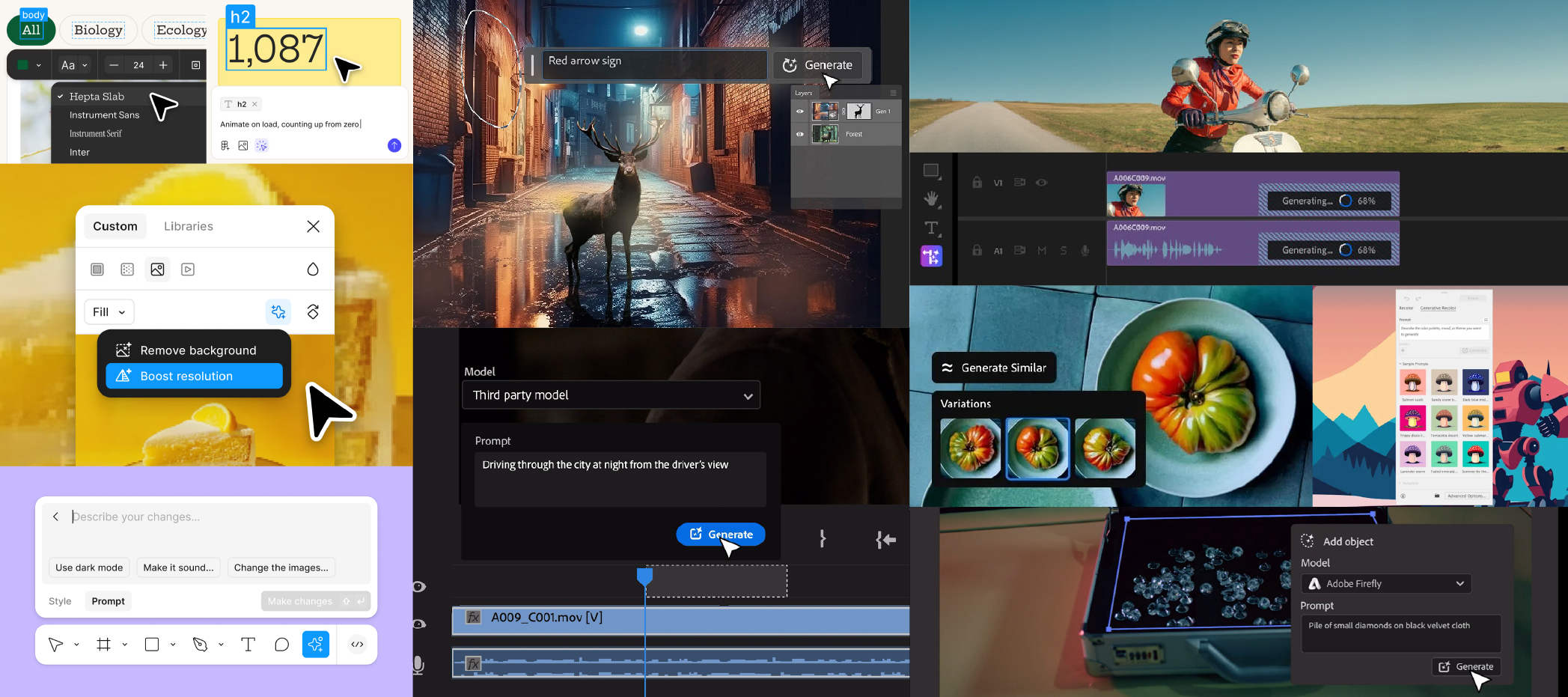
Over the past year, AI quietly shifted from a fun experiment to a very real part of everyday life. You’ve probably felt it already. Photoshop fills, extends, and rebuilds images in ways we would have killed for five years ago. Firefly generates editable graphics and quickly re-colours entire designs. Figma rewrites copy and creates new component variations on the fly. Even mundane work like resizing, renaming, and cleaning up files is all handled in the background.
It’s not replacing creativity. It’s removing the friction around it.
Peter Loomis from Persone Design believes that creativity is adaptive:
“We don’t use AI to cut corners. We do use it to go further, faster – with more experimentation.”
Think of AI as a co-worker who really, really wants to handle all the grunt work so you can spend more time exploring concepts, refining ideas, or actually thinking strategically. This shift does not signal the end of design skills; designers are increasingly valued for their judgment, creativity, and decision-making abilities.
A new kind of tool ecosystem
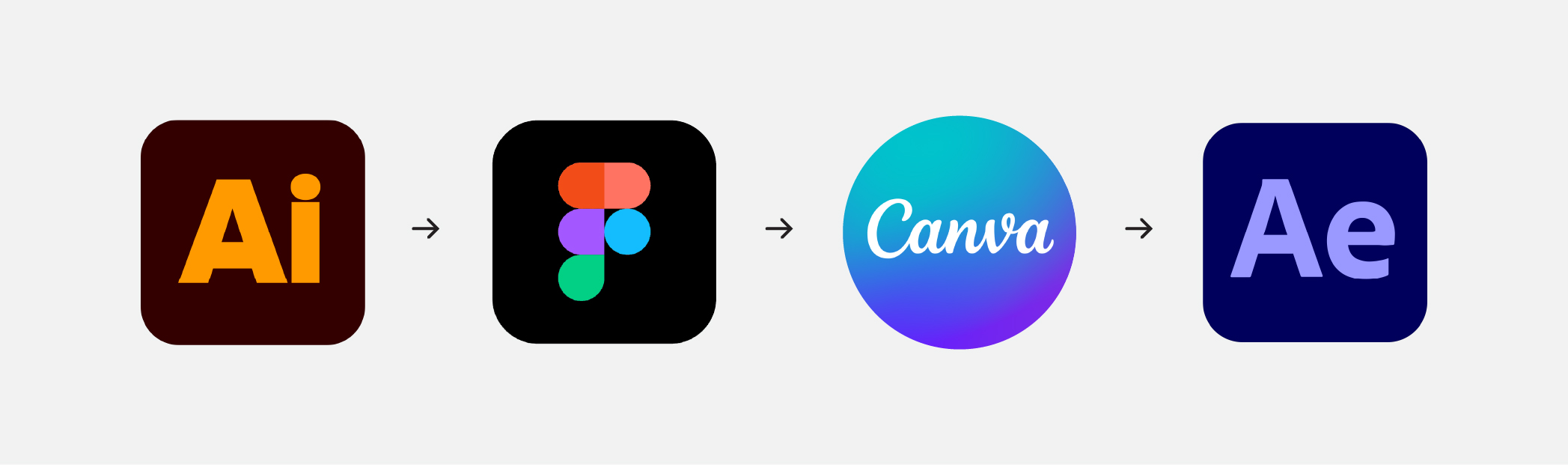
The software landscape isn’t a single-track lane anymore. Adobe has long been the standard for professional design work, but teams aren’t living in one platform the way they used to. One project may start in Illustrator for high-fidelity assets, continue in Figma for collaborative iteration, leverage AI tools to generate variations and end in After Effects for animations. The emphasis is no longer on loyalty to a single tool, it’s on choosing the right tool for the job and optimizing for efficiency, collaboration, and quality.
This means projects feel more modular. Work starts in one tool, evolves in another, and finishes in a third. It’s less about being “an Adobe designer” or “a Figma designer” and more about moving fluidly between each tool—based on which is the right one for the job.
What this means for designers
Speed becomes the new baseline
The biggest change is speed. Not just working faster, but the expectation to work faster. When your tools automate resizing, cleanup, and variations, marketing teams naturally expect more content, more versions, and more adaptability on tighter timelines. Campaigns that used to take a month now move in weeks. Social content that took a day gets turned around in an afternoon.
But speed comes with a cost. Without clear workflows and strong file organization, hybrid tools can turn into a mess: duplicated files, mismatched exports, conflicting templates, and constantly wondering, “Is this the right version?”. The tools might make work faster, but without process, the team gets slower.
Brand consistency becomes harder to protect
Design systems and shared libraries help keep brands aligned, yet the more tools a team uses, the easier it is for brand drift to creep in. One team updates a component, another doesn’t. Someone grabs an old colour palette. Someone else exports a template they think is “close enough.” Suddenly, the brand looks slightly different depending on who designed it.
In 2026, rules, processes, and responsibilities become extremely important. The teams that win aren’t just the fast ones, they’re the ones who have systems that prevent assets from falling out of sync.
Collaboration gets smarter, but more complex
Most design tools now plug directly into project management platforms and approval workflows. It’s convenient because everything lives in one ecosystem. But it also means designers often become the connective tissue between marketing, dev, and leadership. Gone are the days when you’re just delivering assets—now, you’re part strategist, part facilitator, part translator.
This shift also affects hiring. Teams aren’t just looking for someone who can “make things pretty.” They’re looking for designers who can move between tools, understand the impacts, and collaborate with departments that don’t speak “design” at all.
The creative shift: from execution to thinking
As tools take on executional tasks, designers gain back time to think more broadly and creatively. Instead of spending three hours resizing social assets, you can spend those three hours exploring better ideas. Instead of pixel pushing, you’re focusing on narrative, brand, audience, and strategy, the parts of design that AI can’t replicate.
Isrene Shao from DAC Group says,
“Designers are already integrating AI-powered platforms and tools into their everyday workflows in a way that enhances the creative process rather than replacing it. Used wisely, AI can become a launchpad for better ideas, faster iterations, and sharper outcomes.”
But this also means designers need to keep learning. Hybrid workflows require adaptability. AI features evolve weekly. Processes shift. The teams that thrive will be the ones who invest in training, experimentation, and sharpening judgment, not just technical skills.
What’s coming next
Design systems become the backbone of brands
As AI tools and mixed software workflows become part of everyday life, design systems will shift from nice-to-have documentation to the backbone of brand consistency. When teams bounce between platforms, tools, and AI-generated variations, the brand becomes more fragile.
A living design system becomes the anchor. Not just a PDF buried on company file servers, but centralized documentation with component libraries, guidelines, usage examples, and even prompts written specifically for AI tools. Instead of fixing inconsistencies after the fact, the living, breathing system prevents them in the first place.
Hybrid workflows will become the norm
The days of opening a single design app and working there from concept to final export are basically over. Modern design work already jumps across multiple platforms depending on the task, and that’s only going to grow.
Instead of a “one tool” mentality, the new standard is flexibility.
This shift also opens creative possibilities that used to take too long. Designers can test layout variations in seconds, animate concepts with ease, and prototype ideas that used to feel out of reach. The most successful designers in 2026 will be the ones who know when to switch tools, and why.
Creativity becomes strategy
As AI takes over more repetitive tasks, designers will be able to spend more time shaping ideas and less time producing them pixel by pixel. Instead of grinding through production work, designers will focus on the parts only humans can do well: interpreting client goals, understanding their audience, making thoughtful decisions, and directing the creative vision.
Designers become the people who decide which AI-generated direction makes sense, how it needs to be shaped, and if it aligns with the brand or campaign. AI can output thousands of possibilities, but it can’t understand context, cultural relevance, emotion, or business objectives. That’s where design shines.
Continual learning becomes a requirement
Not in a stressful, “reinvent your skillset every 6 months” way, but a “stay curious or get stuck” way. AI tools and design software are evolving at a pace we haven’t seen before, so designers need to keep up. This doesn’t mean you need to master everything. What matters is adaptability. A willingness to try new workflows and stay open to new processes, even if it feels weird at first. Even at events like DesignThinkers, we saw how quickly things are shifting. Hearing experts talk about the evolution of AI made it clear that staying informed isn’t optional anymore, it’s part of the craft.
The designers who thrive in 2026 won’t be the ones who resist change. They’ll be the ones who treat learning as a natural part of the job and use it to stay ahead of what‘s next.
The bottom line
Design in 2026 isn’t about choosing the “right” tool or worrying that AI will replace creativity. It’s about embracing a landscape where our tools finally support the way designers naturally think: fluidly, collaboratively, and conceptually.
The more the tech evolves, the more our value comes from vision, judgment, and the ability to translate ideas into experiences that actually resonate.
If there’s one thing I want you to take away from this post, it’s this:
Designers who stay curious, flexible, and grounded in solid creative thinking will lead the next era of design, no matter what tools come next.

 Podcast