
The key to better ideation: Say the weird idea

Most B2B marketing don’t teams don’t struggle with ideas. They struggle with refining them too early or feeling confined.
Have you ever thought:
- Our campaigns all look the same
- We’re stuck in a rut doing the usual
- We’re struggling to differentiate
Constraints could be killing your ideation
We often put constraints on ourselves, whether these are real like budgets, timelines, resources or preconceived notions. Whatever the constraint, we shut things down too early and end up playing it safe. In a lot of cases, learning to reframe early “bad” ideas, “complex” ideas or “mistakes” is what allows us to better surface ideas in the first place.
“The way to get good ideas is to get lots of ideas, and throw the bad ones away.”
– Linus Pauling
So, how do we actually create space for that kind of thinking?
The foundation for better thinking
Start with the right anchor: the actual problem
To think creatively and without constraints, the first step is defining the problem clearly. A well-defined problem sparks effective solutions, while an unclear one creates chaos.
For example, many organizations assume they “need a new website”. But the website itself is rarely the real problem. What often surfaces is misalignment around strategy, organizational priorities, brand values, or target audiences. This shows up as unclear messaging, a vague value proposition, or a customer journey that does not match how buyers actually think. In short, “We need a new website” is an idea, but not usually the root problem.
The same principle applies to marketing assets. Sales teams often request one-pagers or brochures at the last minute. These requests can seem straightforward, but they are often symptomatic of a bigger issue. Understanding why the request exists and what problem the asset is solving allows marketers to deliver smarter, more strategic solutions instead of quick fixes.
According to the Design Thinking Framework, empathize, define, and ideate are the stepping stones for your innovation.
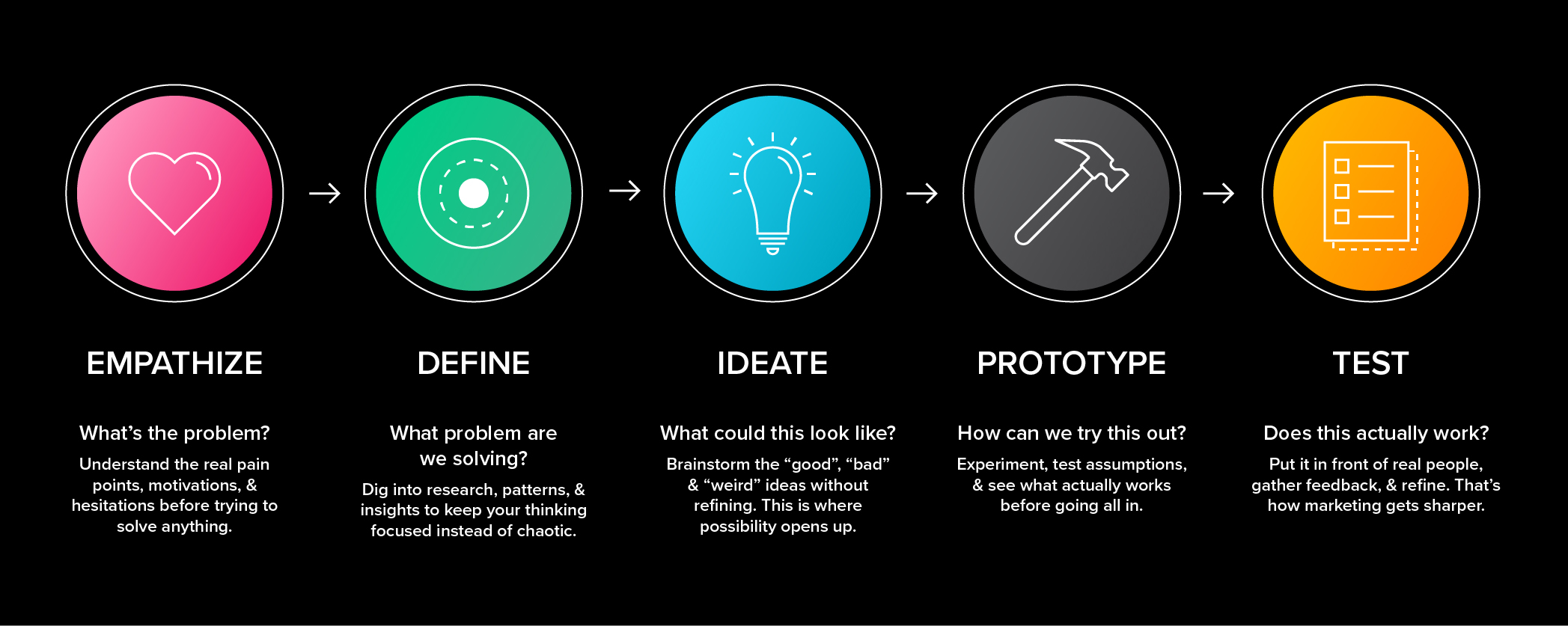
Before practicing unconstrained thinking, you need to clearly define the problem or pain point you are addressing. This ensures your brainstorming is productive rather than chaotic.
Returning to the website example, if the starting point is “We need a new website,” the questions might focus on layout, colors, or functionality. But those questions assume the website is the solution, which can lead to solving the wrong problem.
Once the real issue is identified, such as misalignment in messaging, brand positioning, or the customer journey, the questions shift:
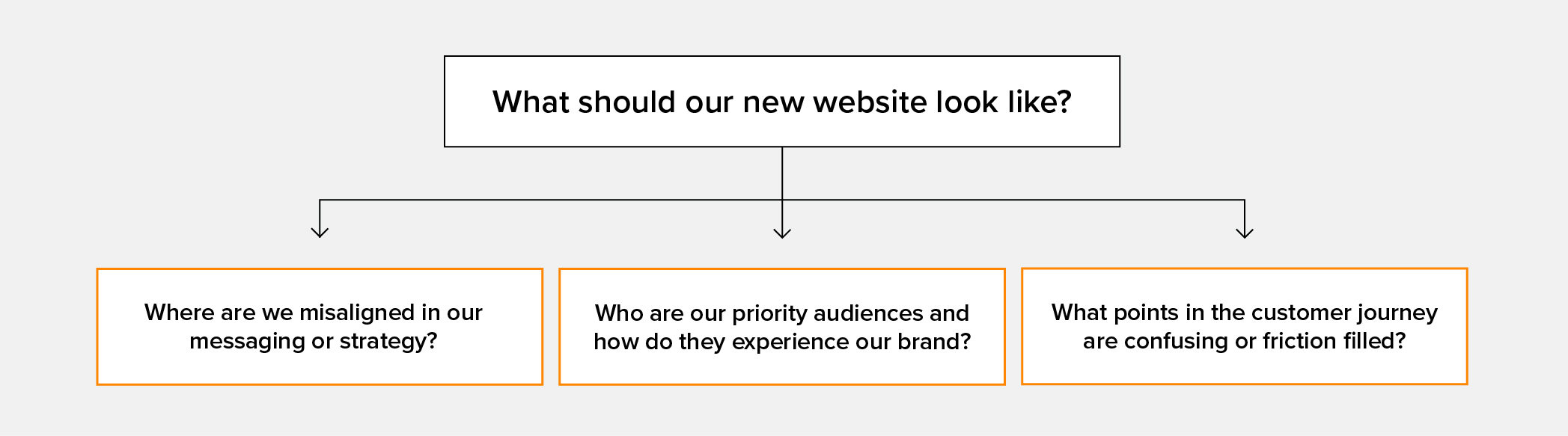
Instead of:
- What should our new website look like?
Ask:
- Where are we misaligned in our messaging or strategy?
- Who are our priority audiences and how do they experience our brand?
- What points in the customer journey are confusing or friction-filled?
Defining the problem first does not limit creativity. It makes it more effective. Even unconventional ideas become useful because they are applied to the right challenge, increasing the chance they reveal meaningful solutions rather than just adding noise.
A toolkit to get your team’s ideas moving
Once the problem’s clear, the hard part is getting your ideas out without second-guessing them. The purpose of this toolkit is to create momentum, not to be perfect. So, with that being said, try one, or try them all, but don’t be afraid to get those ideas out of your head.
Remove the mind barriers
It can be hard to break free from a constrained mindset, especially when real barriers exist. A simple way to start brainstorming is to think as unrealistically as possible, giving yourself and your team room for ideas to surface. Here are a few prompts to get started:
- How would I solve this problem if I had all the money in the world?
- What would I do if speed mattered more than perfection?
- How would I solve this problem if I had unlimited time?
- If I was not copying what others in the industry are doing, what would I try?
- What would I pitch if I was not worried about it sounding unrealistic?
- What is the simplest version of this idea if we stripped it down completely?
These prompts are not about finding the perfect answer right away. They’re about giving yourself permission to think freely without shutting down ideas or yourself. When you bring this approach to a team brainstorming session, it creates an open space where everyone feels comfortable sharing. Even ideas that seem unrealistic at first can reveal new directions. It is much easier to start with a wide range of ideas and then refine them than to have no ideas at all because people feel limited by constraints.
Wrong ideas only
The idea is to flip your brainstorming upside-down by forcing the team to do the opposite of what feels safe. It works exactly how it sounds: set a short time limit with the only rule being that you have to pitch ideas that feel wrong.
By removing the pressure to be right, you’ll break out of everyday thinking and may spark something you wouldn’t have otherwise thought of.
SCAMPER
If you already have an idea, SCAMPER expands it into new directions using a set of prompts:
- Substitute – what can be replaced?
- Combine – what can be combined?
- Adapt – what could we borrow/build on?
- Modify – what can be modified?
- Put to Another Use – where else could this work?
- Eliminate – what can be removed or simplified?
- Reverse – what happens if we flip it?
The point is to take an idea and quickly walk through these questions without overthinking, creating room for improved ones.
Crazy 8s
Think of Crazy 8s as a rapid-fire brainstorm session designed to get your ideas on paper quickly. Set a timer for 8 minutes and write down 1 idea per minute.
This exercise forces you to move away from perfection by taking away any time for you to judge yourself, set constraints, and limit your thinking. Just get those ideas down fast!
Feeling ready to start brainstorming now?
Unconstrained thinking in practice
Let’s take a look at an unconstrained thinking lesson that all Stryvers learned recently. At our all-hands, we split up into teams and were instructed to build the tallest towers we could out of marshmallows and toothpicks. Height was our only guiding principle.
Pause and take a minute to think about how you’d approach this challenge.
If you were thinking about building triangles, well, you’re not alone. Almost every single team thought about triangles being the most structurally sound strategy and rolled with that. In theory, this was a good idea, however we are clearly not architects, so that only got us so far.
Look at our masterpieces…
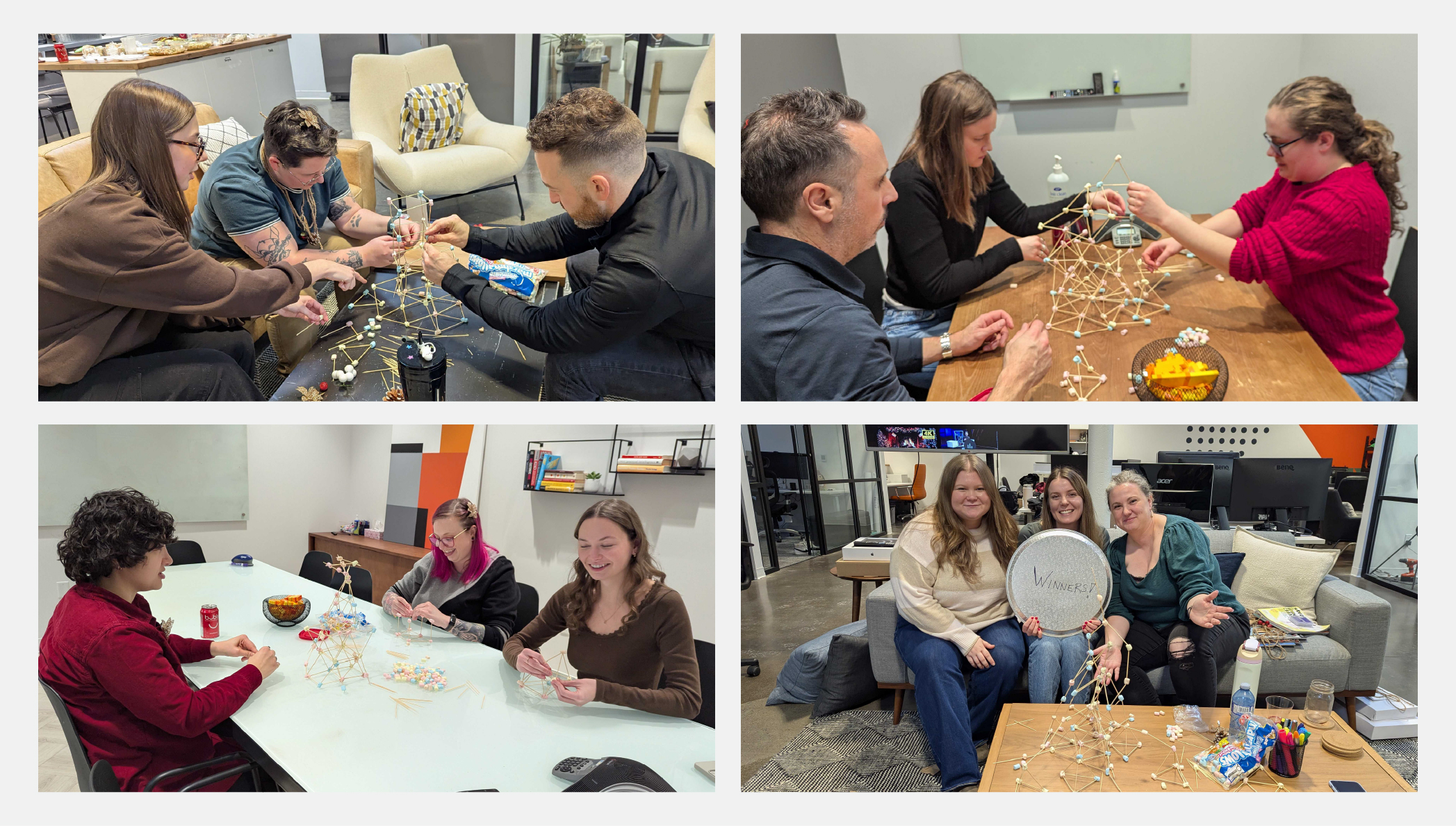
After the activity, we watched a Ted Talk about how children do better at this activity than any business graduate by a landslide. Why? Because they aren’t afraid to use their imagination and aren’t limited by preconceived notions. Adults try to get it right the first time, but kids just keep testing.
The point is, both demographics has the same guiding principle—to build the tower as tall as possible. But one demographic wasn’t bogged down by constraints.
So yeah, let the idea be “bad”
Innovation doesn’t fail at execution; it fails at ideation. When ideas are shut down too early, teams play it safe and settle for the familiar.
Defining the problem gives your ideation direction. Even unconventional ideas become meaningful because they connect to the real challenge you are trying to solve.
Pair that clarity with removing constraints, and you create space for ideas to flow freely. The goal is not to ignore reality, but to explore possibilities before timelines, budgets, and feasibility come into play.
Not every idea will be perfect, and that is the point. Even “bad” ideas are stepping stones to your best ones. Let them exist long enough to see where they might lead.