
How brand and website influence enterprise value in B2B

Your website and brand aren’t just marketing outputs. They’re enterprise assets that directly impact revenue, trust, and how investors or potential buyers perceive your business. In a digital-first world, your website is rarely “just a brochure” anymore. It’s critical infrastructure—a system that powers your business.
If you’re a PE-backed, acquisitive company, or even a growth-focused business, thinking this way can dramatically change how you approach your marketing strategy or think about firms you wish to acquire. Let’s break down how marketing is an enterprise asset that impacts a company’s value.
What we mean by “marketing is an enterprise asset”
Enterprise assets are anything your business owns that generates long-term value. Traditionally, this includes things like:
- Intellectual property like proprietary tech, patents or processes
- Customer data and relationships
- Human capital
- Revenue streams and contracts
- Operational systems
- Brand equity
Brand and websites were considered “soft” or creative, and notoriously hard to measure in a way that finance cared about. That’s no longer the case. And, if you ask us, it’s outdated thinking. Brand, website, and operations are now inextricably linked.
Today, marketing earns its place on the enterprise asset list because it no longer just promotes the business; it operates it. Your website is a measurable expression of your brand, not just an abstract idea but a digital experience that you can track, test, and improve. Not only that, but your website also overlaps with other enterprise assets that are traditionally used for valuation.
How brand and website affect enterprise value
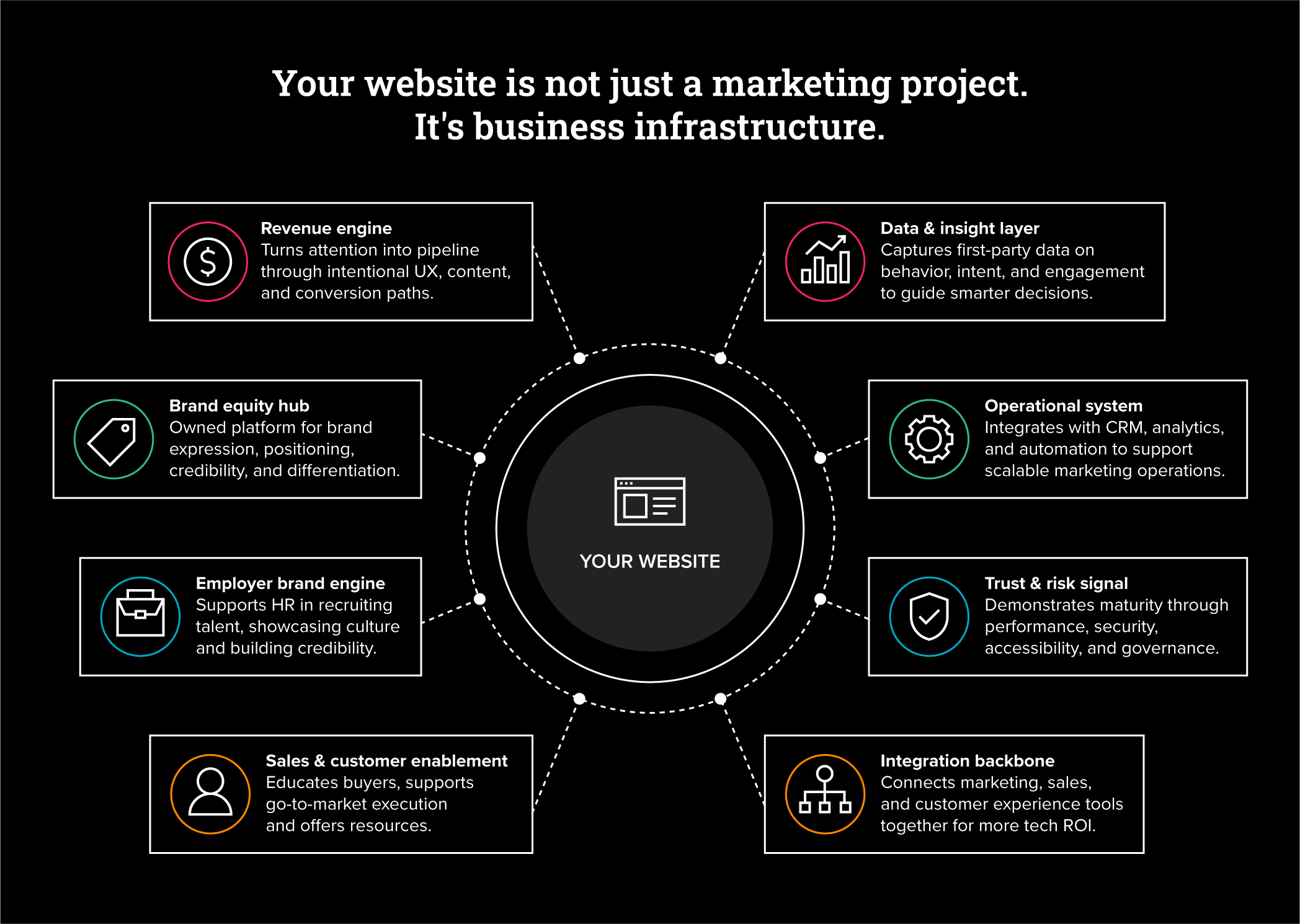
Your brand and website function as revenue infrastructure, customer education platforms, data collection engines, and trust signals all at once. A strong brand paired with a well-built, well-integrated website, on both the front end and back end, shows operational maturity.
This is where marketing stops being a cost center and starts behaving like infrastructure. Strong digital assets can literally change how your business performs.
They influence revenue predictability by creating clearer conversion paths. They improve customer lifetime value through education, guidance, and engagement. They accelerate sales velocity, reduce friction, and support lead qualification. And for investors, they create confidence that your business is intentional, scalable, and operationally mature.
Evaluating the cost and ROI of a B2B website
It’s easy to forget that websites aren’t set-it-and-forget-it once they launch. They’re living systems that require ongoing investment: hosting and infrastructure, security and compliance, content updates, CMS maintenance, performance optimization, and integrations with CRM, analytics, and marketing tools.
The question isn’t whether a website is an ongoing cost (of course it is). The question is whether it compounds value or quietly drains it. How user-friendly your website is, what the back end experience looks like, and how easy it is for your team to manage content, make updates, and adapt the site to your business needs matters just as much. If your marketing team struggles to manage it, if there’s no proper tracking or reporting, or if analytics aren’t set up correctly, your website will never deliver its full ROI.
A strong website supports your target market and your business across departments:
- Marketing uses it to generate leads, educate customers and express the brand
- Sales uses it to qualify and convert leads
- HR relies on it for recruiting and employer branding
- Customer success and support leverage it for onboarding and resources
- Leadership counts on it for credibility and alignment
- Operations uses it for integrations and governance
A weak website does the opposite. It creates friction, wastes time, leaks conversions, and forces teams to build workarounds. A website that’s not living up to its potential should trigger alarms because it’s costing you in efficiency, trust, and ultimately, enterprise value.
When a website becomes a liability
Operational drag
If your site is difficult to update, fragile, or overly custom, your team avoids touching it. Content goes stale. New initiatives stall. Everything takes longer, and momentum disappears. Not only does that stop your team from doing great work but that makes your website a hassle in post-acquisition scenarios. The harder the site is to operate, the more money you’ll need to spend fixing it.
ROI leakage: is your website where you lose people?
High bounce rates, confusing UX, poor navigation, slow performance, broken conversion paths or lack of content quietly kill growth. If your site isn’t usable for all visitors and lacks in accessibility, you’re not just excluding people but limiting your market reach and damaging brand perception. Not convinced?
- Clutch conducted a study on web experiences that showed 94% of users value easy navigation while 83% stated an attractive up-to-date design is highly valued.
- A Google study identified that bounce rates grow 32% when the time it takes to load a page is as slow as 1-3 seconds.
- UX research states that brands miss out on 35% potential revenue due to poor user experience.
That means if not set up well, any traffic that arrives risks getting the wrong impression, low engagement, and minimal conversions. Naturally, every marketing dollar funnelled to paid campaigns delivers less return if you’re sending people to a weak digital experience. In effect, you’re asking your marketing team to drive demand into a system that isn’t designed to convert it. That leaves sales teams thirsty for leads and everyone feels the drought.

Trust and risk erosion
Digital impressions count. Outdated design, inconsistent messaging, and clunky experiences aren’t just “unpolished.” When your primary digital touchpoint looks unreliable, the business behind it feels unreliable, too.
Your website is often the first, and sometimes only, direct interaction people have with your brand. According to Google, the average user forms an opinion about a website in 0.05 seconds. If that experience feels slow, confusing, inaccessible, insecure, or fragmented, it quietly erodes trust. Customers hesitate to convert. Partners or investors question credibility. Missing privacy standards, weak security signals, or outdated UX don’t just hurt perception, they raise perceived operational and reputational risk.
Integration gaps compound the problem
When your website doesn’t communicate with your CRM, analytics, or marketing automation, you risk missing out on serious data. Decisions get made with half (or less) of the story.
From an enterprise value perspective, this matters more than people think. Your tools, processes, and customer data are part of what makes your business scalable and attractive long-term. If your website is disconnected from the rest of your stack, growth looks harder to repeat and harder to trust. In a world where first-party data and owned channels matter more than ever, your website has to work for you.
Individually, these issues are frustrating. Collectively, they quietly erode value and growth potential. You can even think of it as contributing to technical debt. Your website becomes a liability when it doesn’t do your brand justice, creates friction for your target market, and causes headaches for your internal team to manage.
How to start thinking about your website differently
By now you understand that your website is a critical part of your business infrastructure. It houses brand architecture, brand expression, positioning, key interactions that fill your pipeline, and tons of data. You need to treat it like a system.
Ask questions like:
- Does the UX guide users toward outcomes that matter for the business?
- Are conversion paths intentional, measurable, and optimized, or accidental and unclear?
- Is our site fully integrated with CRM, analytics, and automations?
- Is our marketing team able to make data-backed decisions?
- Are we learning from user behavior, or just collecting traffic?
- Are updates strategic or reactive?
- Are accessibility, performance, and usability supporting market reach or limiting it?
- Does our content warm up buyers and support long sales cycles?
- Is the back end experience easy for our team to manage without constant technical debt?
- Does the website accurately reflect the brand?
- Is the website developed in a way that’s scalable to our business needs over the next 2 years?
Marketing is a strategic business asset
Start thinking of your website as something your business runs on. View marketing as an opportunity for enterprise value creation. A well-designed, well-maintained, and integrated website drives revenue, builds trust, and makes your business scalable and investable. For PE-backed firms or those experiencing M&As, this also affects valuation, integration speed, and how attractive the company looks to buyers. How your website is built to host your brand and support business operations can be a massive competitive advantage so it’s time to change how we think about this marketing function.
Start with our website brief template
Your website is a critical business asset. It deserves a clear strategy. Our website brief template helps teams align on goals, structure, integrations, and success metrics before a project begins.
Download the template and start planning your next website with intention.

 Download




 Deck
Deck